parasol's 5-phase trading pipeline
10,400 tokens launch on Solana every day. 98% go to zero. 82.8% show signs of manipulation within their first 24 hours. the handful that survive and grow are buried under an avalanche of rugs, honeypots, and wash-traded noise.
finding the good ones isn't a human-scale problem anymore. parasol runs a continuous pipeline that processes this entire flow autonomously, scan, filter, score, execute, protect. five phases, running in a loop, 24 hours a day.
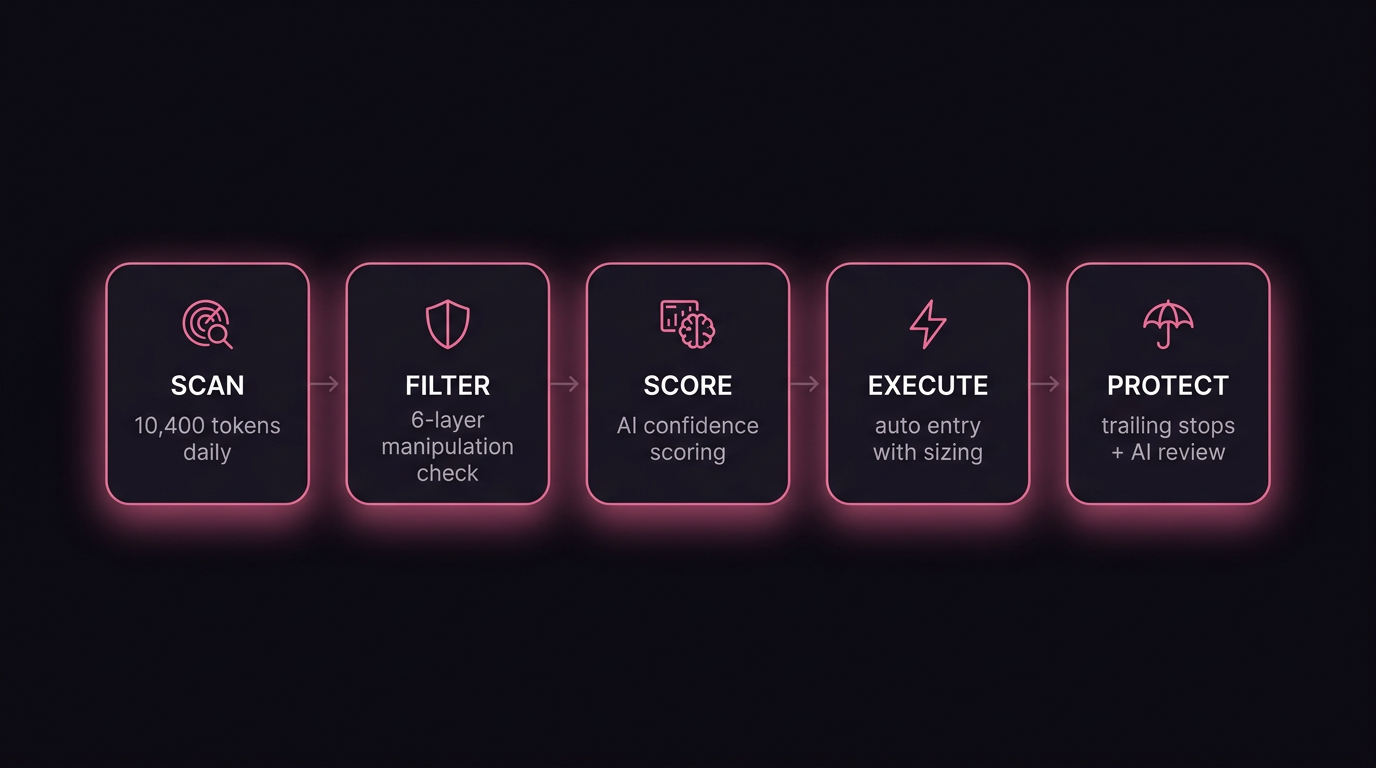
01
02
03
04
05
phase 1: scan
the scanner is the engine's eyes. it monitors multiple data sources simultaneously, looking for tokens that meet baseline criteria for further analysis.
data sources
parasol doesn't rely on a single data feed. single-source scanners miss things. apis go down. data arrives late. if your only source is dexscreener and dexscreener lags by 30 seconds, you're 30 seconds late on every opportunity.
the scanner pulls from:
dexscreener; new pair listings, volume data, price action across solana dexes.
helius websocket. Real-time on-chain events streamed directly from solana via helius rpc. catches token transfers, liquidity events, and large transactions as they happen.
pumpportal, monitors pump.fun launches specifically. tokens launched there have a distinct lifecycle (bonding curve → raydium migration) that requires specialized monitoring.
birdeye, token analytics including holder counts, transaction history, and liquidity depth.
smart wallet tracking; monitors a curated set of wallet addresses known to be consistently profitable. when these wallets buy a token, it gets flagged for analysis. this isn't copy trading. The buy is a signal, not a trade trigger.
social signals, monitors mentions on x and telegram for tokens gaining social momentum. social signals alone don't trigger trades; they boost the score of tokens already identified through on-chain data.
what passes scan
a token passes the scan phase if it meets minimum thresholds: liquidity, volume, price action, and age. tokens that don't are discarded. a few dozen typically pass per cycle out of thousands detected.
phase 2: filter
the filter is parasol's core defensive layer. its job: reject manipulated tokens before any capital is risked.
most token scanners stop at "does this token have volume and liquidity?" parasol asks six more questions.
check 1: holder concentration
if the top 10 holders own 60% of a token, any of them can crash the price by selling. the filter queries on-chain holder data and calculates the full distribution. Including gini coefficient. extreme concentration gets rejected.
check 2: sniping detection
snipers buy in the same block as token creation. they're insiders who dump on retail traders who find the token later. the filter examines earliest transactions and flags wallets with sniper history.
check 3: liquidity analysis
unlocked liquidity means the deployer can rug at any time. the filter checks total depth, lock status, and the liquidity-to-market-cap ratio. a $500k market cap on $2k liquidity is a trap.
check 4: wash trading detection
volume is the most commonly faked metric in crypto. the filter analyzes circular transactions, timing patterns, and the ratio of unique wallets to total transactions. real volume is often a fraction of what's reported.
check 5: honeypot detection
a honeypot lets you buy but not sell. the filter simulates a sell transaction without executing it. if the simulation fails or returns an unreasonable tax, the token is flagged.
check 6: dev wallet analysis
the deployer has the most information and power. the filter traces their wallet history; previous tokens deployed, outcomes, current selling behavior, connections to known scam wallets.
the filter in practice
``
scanned: 847 tokens
passed scan: 43 tokens
rejected: 39 tokens (holder conc, sniping, liquidity, wash trading, honeypot, dev wallet)
passed all: 4 tokens
`
43 candidates reduced to 4. 91% rejection rate. normal. the four survivors aren't guaranteed to be profitable, but they've passed a gauntlet that eliminates the most common ways traders lose money.
phase 3: score
tokens that survive the filter enter scoring. this is where parasol evaluates how good the opportunity is, not just whether it's safe.
momentum analysis
the scorer calculates momentum across multiple timeframes: 5-minute (immediate), 15-minute (short-term), 1-hour (medium-term). momentum isn't just "price went up"; volume behind the move, consistency, and acceleration all factor in.
strategy profiles
parasol runs three strategies simultaneously:
momentum; strong directional moves backed by volume. breaking out of consolidation with increasing participation.
mean reversion. Overextended tokens likely to pull back. oversold conditions where the bounce risk/reward is favorable.
breakout, approaching key price levels with accumulating volume. enter as the breakout happens.
each strategy produces an independent score. the engine trades the one with highest conviction for each token.
adaptive weight learning
at trade entry, parasol captures a feature snapshot, every signal that led to the trade. when the trade closes, the outcome is paired with that snapshot. signals that correlate with wins get boosted. signals that correlate with losses get suppressed.
learning happens at three levels: global, market-regime-specific, and regime+strategy-specific. the engine gets smarter with every trade it makes.
phase 4: execute
live trading
live trading uses the same logic with real transactions. trades are signed through turnkey mpc wallets. The private key is split across multiple parties. parasol never has unilateral access to your funds.
once a position is open, the engine manages it actively: trailing stop updates with each new bar, take profit orders execute at predefined levels, partial exits happen automatically on laddered targets.
phase 5: protect
atr trailing stops
every position has a trailing stop based on the token's average true range. a fixed 5% stop on a token that normally moves 8% per day gets triggered by noise. atr-based stops adapt to the token's actual behavior and never move down, only up.
take-profit laddering
instead of closing the entire position at one target, parasol exits in stages, locking in partial profits while keeping exposure to larger moves. the trailing portion can ride a 10× move if it develops.
daily kill switch
if the account hits the daily loss threshold, all trading stops. open positions close. no new trades until the next day. non-negotiable. this is the circuit breaker that keeps a bad day from becoming catastrophic.
consecutive loss cooldown
after three consecutive losses, the engine pauses for one hour. three losses in a row usually means current market conditions don't match the strategy's assumptions. the cooldown forces a pause before more capital is risked.
the pipeline in practice
`
[scan] 847 tokens detected across 7 sources
[scan] 43 pass minimum thresholds
[filter] 39 rejected
[filter] 4 tokens pass all 6 checks
[score] token A: 78 confidence (momentum)
[score] token B: 64 confidence (breakout)
[score] token C: 51 confidence, below threshold, skip
[score] token D: 42 confidence, below threshold, skip
[execute] token A: buy at $0.0082
[execute] token B: buy at $0.41
[protect] token A: stop $0.0071, tp1 $0.0098, tp2 $0.0115
[protect] token B: stop $0.37, tp1 $0.49, tp2 $0.57
``
this cycle runs continuously. when conditions are quiet, cycles produce no trades. the engine doesn't force entries; the best trade is often no trade at all.
what this means for you
if you've traded memecoins manually, you've done this pipeline in your head. you checked dexscreener (scan), looked at holders on solscan (filter), read the chart (score), clicked buy on phantom (execute), set a mental stop (protect).
the difference is time, consistency, and discipline. the pipeline processes hundreds of tokens per minute. it applies all six manipulation filters every time without exception. it sizes positions mathematically. it never skips the holder check because a token "looks legit."
automation doesn't guarantee profits. what it guarantees is consistency, the same process, the same rigor, the same risk management, every single trade. over hundreds of trades, consistency is the edge.
parasol runs this pipeline continuously on solana. request access →