parasol as a trading companion: the AI layer that runs alongside axiom and trojan
the question is not "which platform should I use." the question is "what is each platform good at, and how do I combine them."
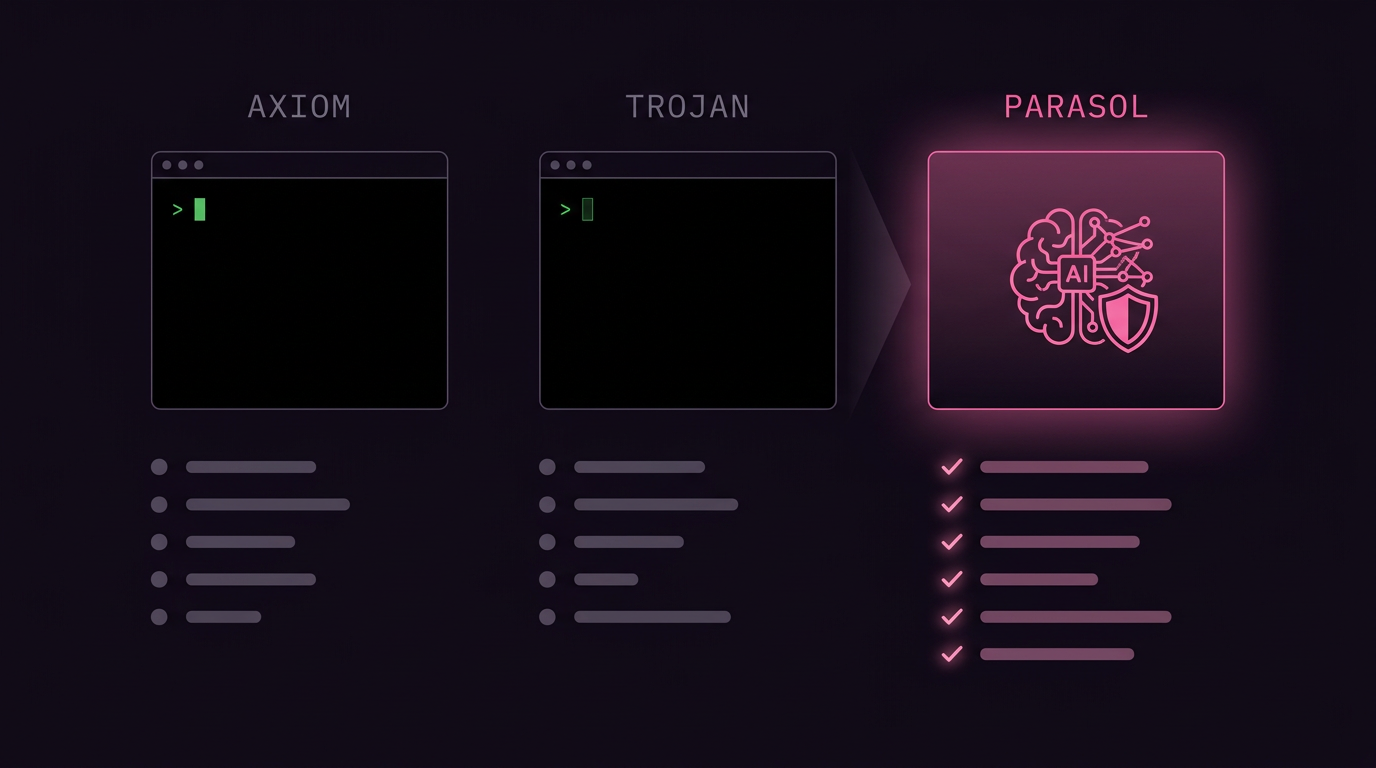
trojan is the fastest execution engine on solana. axiom is a clean web terminal with strong analytics. parasol is the AI layer that neither of them has. Autonomous research, manipulation filtering, and adaptive position management.
they are not competitors. they are layers in a stack.
why one platform is not enough
every solana trading platform makes trade-offs:
trojan optimised for speed. sub-100ms execution, trenches for token discovery, copy trading, perps. if you need to be first into a trade, nothing beats it. but speed without filtering means you are fast into bad trades as often as good ones. and once you are in, position management is manual; static stops, static take profits, no adaptation.
axiom optimised for analysis. clean charting, portfolio analytics, configurable trading logic. if you want to study a token before entering, axiom gives you the tools. but it does not find the tokens for you, and it does not manage your positions after entry beyond the rules you set.
parasol optimised for intelligence. autonomous scanning across 10,400+ daily token launches, 6-layer manipulation filter, multi-strategy scoring, AI-reviewed entries, and adaptive exit management. it is not the fastest execution engine and it is not the best charting terminal. it is the layer that thinks.
the strongest traders in 2026 are using all three.
the combined stack
layer 1: parasol for discovery and filtering
parasol runs continuously in the background. every scan cycle, it:
this is your filtered briefing. instead of scrolling through thousands of new launches, you check the watchlist. the noise is already gone.
layer 2: axiom for deep analysis
when a token appears on parasol's watchlist that interests you, open it on axiom. use axiom's charting to confirm the setup; check support/resistance levels, volume profile, order flow. axiom's analytics are excellent for this kind of focused analysis.
parasol narrowed the field from 10,400 to 5. axiom helps you decide which of those 5 to enter.
layer 3: trojan for execution
when you are ready to enter, execute on trojan. fastest fills on solana, MEV protection, and if you need to snipe a launch or catch a breakout in real time, trojan's speed is unmatched.
layer 4: parasol for management
once you are in the position, however you entered; paste the CA into parasol. the agent picks up management from that moment:
you entered on trojan for speed. parasol manages the exit with discipline.
three workflows for three types of traders
the speed trader
you live in trojan's trenches. you see a token moving, you buy it in seconds. your edge is speed.
your problem: you are fast into trades but slow out of them. you hold winners too long watching them reverse. you move stops on losers hoping they recover. your entries are sharp but your exits cost you money.
add parasol: after every trojan entry, paste the CA into parasol. the agent manages the exit, trailing stop, take profit ladder, AI review. you keep your speed edge on entries. parasol adds discipline on exits.
result: same entries, better exits. the combination of trojan's speed and parasol's management is stronger than either alone.
the analyst
you study charts on axiom before every trade. you check holders, volume, liquidity. you are careful and methodical.
your problem: research takes hours. you analyse 20 tokens to find 2 worth entering. and even after careful analysis, you miss manipulation patterns that are invisible on charts. Wash trading, coordinated sniping, hidden holder concentration.
add parasol: use parasol's scanner as your starting universe instead of twitter or telegram. the manipulation filter catches what chart analysis cannot. you still do your own analysis on axiom, but you start with tokens that have already passed 6 layers of quality checks.
result: research time drops from hours to minutes. quality of your starting universe goes up because the manipulation filter is doing work that no amount of chart-staring can replicate.
the hands-off trader
you want exposure to solana memecoins but you do not want to watch charts all day. you have a job, a life, other things to do.
your problem: every other platform requires you to be present. trojan needs you to find and execute trades. axiom needs you to set and monitor rules. if you are not watching, nothing happens.
add parasol as the primary layer: let the agent run autonomously. it scans, filters, scores, enters, and manages, 24/7 whether you are watching or not. check in once a day, once a week, or whenever you feel like it.
keep trojan for manual trades when you spot something yourself. keep axiom for portfolio review. but let parasol do the daily work.
result: trading happens whether you are present or not. the agent does not get tired, does not get emotional, does not move stops.
what parasol adds that terminals cannot
terminals are tools. you use them. parasol is a companion. it works alongside you.
it learns. the adaptive learning system captures feature snapshots at trade entry and pairs them with outcomes. over time, it boosts signals correlated with winners and suppresses signals correlated with losers. the system gets better the more it trades.
it protects. the 6-layer manipulation filter is not something you can replicate manually. it cross-references holder patterns, transaction timing, liquidity depth, and volume authenticity across multiple data sources simultaneously. this runs on every token, every scan cycle.
it adapts. exit levels are not static. trailing stops tighten as profit grows. AI reviews catch pattern changes that static rules miss. market cap-adaptive exits adjust parameters based on token size. the management evolves with the position.
it diversifies. parasol runs multiple agent strategies simultaneously. Momentum, breakout, volume surge, quality-focused, whale watch. each strategy sees different setups. the diversification across strategies reduces the impact of any single bad trade.
none of this exists on axiom or trojan. not because they are bad platforms. They are excellent at what they do. but they are execution tools. parasol is the intelligence layer.
the cost of not having a companion
without an AI companion layer, you are responsible for:
with parasol as the companion layer:
the terminal gives you the ability to trade. the companion gives you the ability to trade well.
try the stack
get access at parasol.so, fund your wallet, and let the agent run. keep using trojan for speed. keep using axiom for analysis. add parasol as the layer that makes both of them better.
already use trojan or axiom? one terminal for speed. one terminal for analysis. one companion for intelligence. that is the stack.